Showing posts with label Meditative. Show all posts

Bishop | 2013 | Trilogía

Lo-fi Electronica | Ambient
Info | Escucha
Enlace | mp3 | 320 Kbps
In October 2013, Bishop's untitled trilogy –consisting of albums Dock Sud, La Era del Gran Ordenador and ROM– confirmed once again that the Argentine's music has no equal.
Each one with a unique spirit, the records that constitute this colossal work are fueled by honest humanity and a sound that is both simple and profound, and which in its minimalism manages to create emotive, captivating and purifying atmospheres. In sum, this trilogy is a true cathartic process, beginning with Dock Sud, which has somewhat more crude and nervous nuances, then through the dreamier and more delicate La Era del Gran Ordenador, and finishing with ROM, of a more intense and liberating sound, constituting the big treasure within a trilogy that has no low points, thus closing on a high note one of the key albums from 2013 and, in general, an essential piece in the collection of any lover of soulful music. —IMF

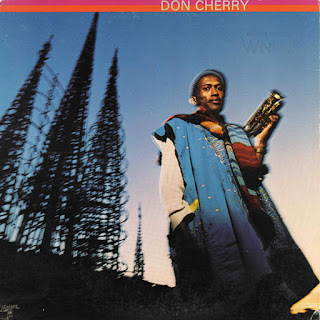
Don Cherry | 1975 | Don Cherry

Spiritual | Avant-garde Jazz | Fusion
Listen
Link | mp3 | 320 Kbps

Don Cherry (trumpet, electric piano and vocals), Frank Lowe (saxophone), Ricky Cherry (piano and electric piano), Charlie Haden (bass), Billy Higgins (drums), Bunchie Fox (bongos on "Brown Rice"), Verna Gillis (vocals on "Brown Rice"), Moki Cherry (tanpura on "Malkauns") and Hakim Jami (bass on "Chenrezig")
Don Cherry's self-titled album (also known as Brown Rice on later reissues) is one of the pinnacles of his career, even when his works with Ornette Coleman are taken into account. With only four songs, it constitutes a true journey, one of Don's masterpieces.
"Brown Rice", the album opener, is psychedelic, catchy, hypnotic; it sounds almost like psych-folk/drone from the past decade. The bass fuzz is brilliant, and Don's cryptic vocals and Verna Gillis's incessant oniric chant submerge you into an unparalleled trance, to which Billy Higgins and Bunchie Fox's percussions (Higgins was a close friend of Cherry and his bandmate in The Ornette Coleman Quartet) certainly contribute.
In contrast to the dancing voluptuosity of "Brown Rice", the second track of the album, "Malkauns", shows greater timidity right off the bat. Charlie Haden's (another legendary musician, who was part of Coleman's classic quartet too) bass intro, acompannied by Moki Cherry's (Don's wife) tanpura, helps establish an introspective, melancholic and somewhat bleak atmosphere, on the top of which Don weaves a trumpet improsation that confirms the song's rather sad tone, but with a cheerful, cathartic, liberating melancholy. Per Higgins's drums, the atmosphere progressively transmits more confidence, more safeness; the feeling that life is sad sometimes, but things will be alright. Beautiful song.
For its part, "Chenrezig" deepens more directly into the Eastern influences of Cherry's music. Don's vocals virtually turn into throat singing, building a cryptic environment which opens up slowly. Later on, a more traditional jazz element comes into play, with a brilliant, subtle and dissonant piano comping by Ricky Cherry. And at the end, the explosion, chaos, liberation, with Don Cherry improvising frantically and noisily in the trumpet.
Lastly, "Degi-Degi" is almost an afrobeat piece, albeit with no predominant percussions. Ricky Cherry's electric piano garnishes the trance with a comping that owes a lot to Indian music and over which Don narrates an unintelligible script in a cryptic tone, while Frank Lowe energetically improvises in the tenor sax and, with his characteristic wit, Charlie Haden entwines an hypnotic bass melody.
Thus, in a nutshell, Don Cherry is an absolutely brilliant, dynamic and vital album. —IMF

Brian Eno | 1985 | Thursday Afternoon

Ambient | Minimalism
Info | Listen
 Link | mp3 | 320 Kbps

What can be said about Thursday Afternoon is not very different from what one might comment on Brian Eno's other ambient records. Somehow, it is an album that lies between the more structured ambient of Ambient 1: Music for Airports and the more deconstructive and exploratory approach that Eno adopted in Lux. In that sense, Neroli might be a good close reference, albeit Thursday Afternoon resorts to much calmer and pacific atmosphere than the tension that reigns in Neroli.
Consisting of a single, eponymous track of just over one hour, the sound of Thursday Afternoon is both relaxing and dreamy, and has a delicacy of unparalleled beauty in its fragility. Each sonic brushstroke is simple and even timid, but always conscientious; each brushstroke contributes to the development of colourful, yet never sparkling soundscapes, but subtle and nebulous ones. In sum, Thursday Afternoon is one of the hidden gems in Eno's vast catalog, a record whose relegation within his discography would seem baffling to anyone who undertakes the beautiful instrospective journey which is found here. —IMF

A Full Cosmic Sound / Ø+yn ‎| 2016 | Split

Drone | Ambient | Experimental
Info | Buy | Listen
This nameless split brings together two of the most relevant bands within the current Latin American experimental scene, each one with a vast and fertile discography. Thus, it already sounded like a promising album on paper and, luckily and by virtue of both band's talent, it's up to the expectations.
In both parts of "Obsidiana" –which form the first half of the split–, A Full Cosmic Sound undertakes a beautiful ambient exercise in which a meditative and melancholic sound predominates. The band's remarkable merit is to have deconstructed its sound –always experimental and hypnotic– and to have taken it to its minimal expression, to its most primal and bare essence. The minimalist approach that AFCS adopted in "Obsidiana" has an evident genius to it and is a reflection of the different routes that the Santiago collective can undertake with no risk of getting lost. This is one of the highest points of their discography, no doubt.
On the other hand, although "En cromo" is not as innovative as the first half vis à vis the expectations that one could have in the face of Ø+yn's style, the sonic experiment towards which the group heads down does not pale in contrast to the first part of the split. Quite the opposite: while keeping the listener in trance, the band resorts to field recordings and to a sonic journey with a tribal and shamanic feel to garnish that introspective trip with psychedelic nuances and atmospheres that, albeit just as primal as those of A Full Cosmic Sound, are developed in Ø+yn's own language.
In their split, AFCS and Ø+yn simultaneously achieved cohesion and eclecticism in an album that, in sum, confirms the relevance and splendour of both collectives. It is, thus, advisable to listen, to immerse yourself and to, simply, lift your feet off the ground. —IMF

Cluster | 2016 | Konzerte 1972/1977

Experimental | Drone | Ambient
Info | Buy
Link | mp3 | V0 (ripped by us)
Certainly, a good portion of the interest surrounding the 1971-1981 box set, recently released by Bureau B, lied upon Konzerte 1972/1977, the ninth album in this collection, consisting of previously unreleased live recordings of Cluster. Particularly, the album contains two tracks: one recorded in 1972 in Hamburg, Germany, and the other recorded in 1977 in Metz, France.
If one takes the duo's discography as a benchmark, the fact that Cluster's sound is so similar in both tracks might be odd. In 1972, the band released Cluster II, so, although that album already incorporated more melodic sounds than Cluster 71, the highly experimental approach that shows up in "Fabrik, Hamburg 1972" is not unexpected. By contrast, in 1977 Cluster had already published Zuckerzeit –a pivotal milestone in their discography, with a decidedly more melodic sound than its predecessors–, Sowiesoso and Cluster & Eno –albums that, albeit more ambient-oriented, persisted in that direction–, such that "Festival International de la Science-Fiction, Metz 1977" might be surprising.
Nevertheless, in the first place, the duo's various live albums –Live in Vienna (which was omitted from this collection, strangely), Japan 1996 Live, First Encounter Tour 1996 and Berlin 07– already reflected the fact that Cluster's live performances followed their own path, parallel to their studio work. In fact, the one element that characterizes those live records is, precisely, their undeniably experimental spirit. Secondly (and nuancing what I have just said), throughout the band's trajectory that exploratory character did show a clear evolution, which looms out in the two tracks that form Konzerte 1972/1977. Thus, whereas in Hamburg the sonic ramblings were more erratic and multiform, in Metz Roedelius and Moebius (RIP) already had developed their own language, a peerless telepathy that enabled them to build the hypnotic and meditative atmospheres so unique of Cluster's sound in a much more conscientious and pacient manner.
Beyond its collecting value, Konzerte 1972/1977 is an album which, like much of Cluster's discography, conceals behind its cryptic nature an artistic value that does not show up just like that, but that is certainly there. The sonic sensitivity and the inextinguishable creativity of Roedelius and Moebius's society are as pronounced here as in any other point of their vast trajectory, and recordings like this just confirm to what extent Cluster's immesurable legacy has been underrated, a fact to which the inalienable modesty of both musicians certainly contributed.
Cluster may have come to an end, but that creative spirit, that soul of exuberant emotivity and honesty glows as alive as ever in the music the duo produced across its almost four decades of sonic alchemy, and Konzerte 1972/1977 is yet another reminder of that. —IMF

NEU! | 1975 | NEU! '75

Krautrock
Info | Buy | Listen
Link | mp3 | 320 Kbps

Michael Rother (guitar, piano, vocals, synthesizer, electronica), Klaus Dinger (guitar, piano, vocals, percussion, organ), Thomas Dinger (drums), Hans Lampe (drums)
In late 1974, Michael Rother and Klaus Dinger were not newbies anymore. NEU! had already released two essential records (Dinger had also played on Kraftwerk's self-titled debut), after which the duo undertook divergent paths for a few years.
Rother fled from the agitation of urban life in Düsseldorf and moved to an old rural house along with Hans-Joachim Roedelius and Dieter Moebius from Cluster. With them, he formed Harmonia, whose debut, Musik von Harmonia, was recorded in the second half of 1973. The new trio would be characterized by its pastoral, restful and dreamy sound, which owed a lot to Cluster's ambient, yet not leaving aside Rother's melodic vocation, which would in turn leave a mark on the Berliners.
On the other hand, Klaus Dinger founded Dingerland, a music label through which he released Lilac Angel's debut album, which he had also produced, in 1973. However, his endeavor would prove financially disastrous, so that shortly after –and in spite of Dinger's consternation– Dingerland was forced to close. Thereafter, the idea emerged of forming La Düsseldorf along with his brother Thomas and Hans Lampe, a sound technician in Conny Plank's legendary studios (Plank had produced NEU!'s first two albums).
This was the context in which Michael Rother and Klaus Dinger would reunite: whereas Rother was submerged in the peaceful and introspective rural life, Dinger was enraged against the music industry and the elussive success that was taking so long to arrive. NEU! '75 would be exactly the result of such dicotomy. The duo agreed to devote the first half of the album to Rother's vision, tinged with a more ethereal and spiritual sonic quest, and the second half to Dinger's vision, effervescent of an energy that was both creative and destructive, owing to the ups and downs that he had had to face. The result of this dynamics was one of the most classic krautrock albums ever, in which NEU! managed to reformulate their sound without leaving behind the lessons learned in NEU! and NEU! 2, but at the same time introducing the new languages for which Rother and Dinger were advocating, each one from a different standpoint.
"Isi" opens up the first half of the album with the same formula that "Hallogallo" and "Für Immer" had applied in the records that preceded NEU! 75: hypnotic and dynamic motorik, which this time, however, appears nuanced by Michael Rother's greater sonic delicacy. "Seeland" and "Leb' Wohl" then confirm the new spirit, being two of the most beautiful and fragile songs in NEU!'s discography, with an atmospheric, romantic character à la Caspar David Friedrich, not uncommon in Rother's solo works. Conversely, "Hero" bursts into the scene carelessly with an energic and, at this stage, legendary proto-punk, with the undeniable mark of an explosive-as-usual Klaus Dinger. "E-Musik" follows this path, albeit closer to NEU!'s usual sound, while "After Eight" closes the album with a new electrifying and liberating proto-punk burst. The perfect closer for an undeniable masterpiece, for an album that would close NEU!'s original trilogy on a high note and that would guarantee the duo's trascendence, its influence until our days and an indelible legend within music history. —IMF

Aidan Baker | 2015 | Ecliptic Plane

Drone | Ambient
One of the disadvantages of discographies as extensive as Aidan Baker's, is that albums like Ecliptic Plane lose the impact that they rightly should have. It is not, certainly, a matter of quality regarding Baker's work; on the contrary, his releases have always been up to the talent that he has always shown since Element, his debut album, and they have a consistency that, beyond their eclecticism, displays a distinctive and unique sound. And yet, Ecliptic Plane stands out even within this rich scenario.
This new record comes back to the most beautiful sound of Baker's work, which is reflected on the return to his most minimalist and classic formula: electric guitar and effects. Thus, the album shows a return to ambient and meditative soundscapes, to subtle brushstrokes that almost imperceptibly build ethereal, dreamy walls of sound, and to that cathartic spirit that is one of Aidan Baker's distinctive marks.
Although there have been various salient releases in the meantime (I could mention, perhaps, Noise of Silence or Liminoid/Lifeforms, or his essential albums with Caudal, in addition to many records with Nadja), Ecliptic Plane is, undoubtedly, Baker's best album since 2006's The Sea Swells a Bit..., which is not little to say. Thus, with its naturalness, its ataraxia and its soul, it constitutes a record that arrived at the right time to celebrate the first decade of Aidan's excellent music journey. Another perfect album. —IMF

A Full Cosmic Sound | 2014 | El Secreto Está en la Miel

Experimental | Drone | Ambient
Info | Buy | Listen
Link | mp3 | 320 Kbps
El Secreto Está en la Miel shows the most ambient side of A Full Cosmic Sound's sound (pun intended), as evidenced since the start with "Traición 73", the A side of this 7", which although is in line with what the band has showed in, for example, its eponymous debut, has a less electronic, more volatile vocation than that album. On the other hand, "El Secreto Está en la Miel", the B side that gives the single its title, is a point-blank drone/ambient experimentation, with an even more ethereal version of the song than the one contained in one of the splits of AFCS with The Mugris. Perhaps, in this sense, the single suffers of something evident: being too short. Ambient takes a little time to develop, and therefore this possibly isn't the most appropiate format for A Full Cosmic Sound's material. But beyond that, El Secreto Está en la Miel constitutes another excellent release by the Chilean collective. —IMF