Bishop | 2013 | Trilogía

Lo-fi Electronica | Ambient
Info | Escucha
Enlace | mp3 | 320 Kbps
In October 2013, Bishop's untitled trilogy –consisting of albums Dock Sud, La Era del Gran Ordenador and ROM– confirmed once again that the Argentine's music has no equal.
Each one with a unique spirit, the records that constitute this colossal work are fueled by honest humanity and a sound that is both simple and profound, and which in its minimalism manages to create emotive, captivating and purifying atmospheres. In sum, this trilogy is a true cathartic process, beginning with Dock Sud, which has somewhat more crude and nervous nuances, then through the dreamier and more delicate La Era del Gran Ordenador, and finishing with ROM, of a more intense and liberating sound, constituting the big treasure within a trilogy that has no low points, thus closing on a high note one of the key albums from 2013 and, in general, an essential piece in the collection of any lover of soulful music. —IMF

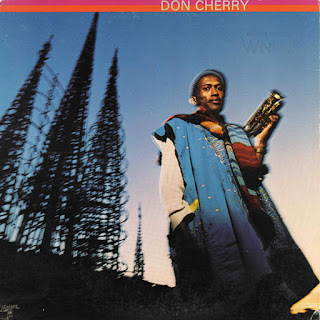
Don Cherry | 1975 | Don Cherry

Spiritual | Avant-garde Jazz | Fusion
Listen
Link | mp3 | 320 Kbps

Don Cherry (trumpet, electric piano and vocals), Frank Lowe (saxophone), Ricky Cherry (piano and electric piano), Charlie Haden (bass), Billy Higgins (drums), Bunchie Fox (bongos on "Brown Rice"), Verna Gillis (vocals on "Brown Rice"), Moki Cherry (tanpura on "Malkauns") and Hakim Jami (bass on "Chenrezig")
Don Cherry's self-titled album (also known as Brown Rice on later reissues) is one of the pinnacles of his career, even when his works with Ornette Coleman are taken into account. With only four songs, it constitutes a true journey, one of Don's masterpieces.
"Brown Rice", the album opener, is psychedelic, catchy, hypnotic; it sounds almost like psych-folk/drone from the past decade. The bass fuzz is brilliant, and Don's cryptic vocals and Verna Gillis's incessant oniric chant submerge you into an unparalleled trance, to which Billy Higgins and Bunchie Fox's percussions (Higgins was a close friend of Cherry and his bandmate in The Ornette Coleman Quartet) certainly contribute.
In contrast to the dancing voluptuosity of "Brown Rice", the second track of the album, "Malkauns", shows greater timidity right off the bat. Charlie Haden's (another legendary musician, who was part of Coleman's classic quartet too) bass intro, acompannied by Moki Cherry's (Don's wife) tanpura, helps establish an introspective, melancholic and somewhat bleak atmosphere, on the top of which Don weaves a trumpet improsation that confirms the song's rather sad tone, but with a cheerful, cathartic, liberating melancholy. Per Higgins's drums, the atmosphere progressively transmits more confidence, more safeness; the feeling that life is sad sometimes, but things will be alright. Beautiful song.
For its part, "Chenrezig" deepens more directly into the Eastern influences of Cherry's music. Don's vocals virtually turn into throat singing, building a cryptic environment which opens up slowly. Later on, a more traditional jazz element comes into play, with a brilliant, subtle and dissonant piano comping by Ricky Cherry. And at the end, the explosion, chaos, liberation, with Don Cherry improvising frantically and noisily in the trumpet.
Lastly, "Degi-Degi" is almost an afrobeat piece, albeit with no predominant percussions. Ricky Cherry's electric piano garnishes the trance with a comping that owes a lot to Indian music and over which Don narrates an unintelligible script in a cryptic tone, while Frank Lowe energetically improvises in the tenor sax and, with his characteristic wit, Charlie Haden entwines an hypnotic bass melody.
Thus, in a nutshell, Don Cherry is an absolutely brilliant, dynamic and vital album. —IMF

Column: What is avant-garde? – Part 1: First world

In general terms, avant-garde is a word used in the arts and politics to refer to innovation, experimentation or revolutionary change. In the less idealistic cases –in which a "re-foundation" is not at stake–, it constitutes a quest which is undertaken in a permanent cycle of construction/deconstruction, as is the case, for exampe, in dadaism or situationism. So, in such terms, how can the avant-garde be thought of in music today?

When we hear the term avant-garde used as an adjective for some piece or song, the first thing that comes to mind is some distraught, dissonant, noisy, disjointed sound that is probably produced through methods alien to those used in what is normally understood as music. But primarily, one expects something new, a sonic, semanthic and existential alternative to the status quo, to the current binary conventions regarding what is good or bad, beautiful or ugly, true or false, etc. But newness is not enough to understand what the avant-garde is. For example, noise music was discovered decades earlier than boy bands, which does not imply that the New Kids on the Block are more avant-garde than Luigi Russolo. The avant-garde is not mere novelty, but rather newness tinged with disruptiveness. It is an aesthetic-political attitude against normalisation, and thus, it implies rebellion and transgression, disobedience and dissent, an interruption of de facto stiffening and openness to every possibility. A critical path, an emancipation of chaos. Music without a past, but also without a future: music free from the museological device of spectacularised history.

I will now suggest a short list with some of the avant-garde milestones that, in accordance with the above, are not such due to their novelty, but especially due to their level of transgression and liberation from rules and injunctions:

John Cage and chance music: This noted US-American composer introduced the possibility of chance, of the uncontrollable, and especially, of the liberation from the traditional method of making chamber music. In the face of Schoenberg's contempt –Schoenberg was his professor and considered that he did not have a melodic ear–, Cage answered that if this was a wall which would keep him from making music, he would beat his head against that wall and make music in such way. Well, especially in his early years, Cage defied the injunctions of chamber music and managed to reformulate music as an open possibility, in which every sound is welcome.

Free jazz: When Charles Mingus started to open the tonal spectrum of jazz, not only was he reaching a new sound, but to some extent, that transgression also symbolised the liberation, the rebellion of Afro-Americans against white dominance. In this sense, the introduction of influences stemming from contemporary classical music to the Afro-American tradition was not the only innovation here, but also the need to express unhinged feelings that would produce the necessary turmoil to dismantle the racist dominance that persisted in the US in those days.

The Velvet Underground and US-American minimalism: Another flank emerged in the US, the very cradle of market industrialisation and of dominance power through sensationalist spectacle: minimalism, which had its more popular by-product in its fusion with rock & roll as undertaken by the iconic The Velvet Underground. La Monte Young, Terry Riley, John Cale, Steve Reich, among others lesser known, created music radically opposed to the magnificence of the entertainment business, resorting to extreme naturalness, to meditation, to humility and to distancing itself from any need to feed the ego. Music thus returned to its ancestral ritual meaning; the West rebelled against itself by looking at Eastern naturalness and rediscovering it in a semi-formal language, or in case of The Velvet Underground, ritualising rock & roll.

Amon Düül II
Krautrock: The post-war era brought about cultural tension, a need to outweigh totalitarianism, the murderous idealism of European fascism. Thus, so-called krautrock emerged as reaction. It basically consisted in an eclectic wave of bands and musicians that brought a sound that was not only innovative, but also free, chaotic, anarchist and deeply psychedelic, generating a new sonic language in which spontaneity embraced uncomitted expression; a language in which, as in free jazz, music meant liberation, a need for chaos and nihilism. Although there are some exceptions, such as Popol Vuh, European non-commercial music, and especially that from early-70s Germany, was always on a quest for moments of sonic deformation, a systemic deformation that "healed" Europe from the idealistic formalism that fascism had imposed years earlier.

Rock in Opposition: Progressive divergence that took the most essential parts of King Crimson's sound and fused it with the dissonance of classical music and jazz, achieving a unique sound in which the lyrical dimension was often politically charged, or in other cases, marginal delusions that redimension the listener's existence. The interesting thing here is that technical mastery are put in the service of shapeless chaos, of a demanding and heavy density.

Industrial music: At this stage, chaos and sonic noise were already experiencing a need for reformulation. Hence the emergence of industrial music, which takes The Velvet Underground's rancid lyricism and fuses it with the sonic extremism of European peripheries (early Kraftwerk or Kluster), thus giving rise to a new language that feeds on the liberty of opening up in the face of the ugly, which had originated in another relatively disruptive genre, known as punk. Let me here paraphrase a remark made by Cosey Fanni Tutti in those years: «TG is not punk, because punk has a determinate form, and industrial music does not». Sadly, industrial music's undefinable spirit got "uniformed" as much as punk's.

Swans
In early and mid 80s, an amorphous creative niche that I find quite interesting and underrated (perhaps precisely due to its deformity) popped in. Two "post" emerged here: post-punk and post-industrial, which somehow constitute a post-avant-garde.

Why do I consider this branches to be particularly interesting? Because, to some extent, the prefix "post" means "where it comes from", but not "where it goes to", and when it is used as a prefix for two transgressive genres per se (punk and industrial), "post" means a transgression of the transgression, deserting us in the midst of a semanthic limbo that left journalists and musicologists speechless, thus resorting to a meaningless use of "post". For the same reason, instead of summing up the "genre", I chose some bands that especially reflect the iconoclast spirit of these non-movements (I will also include so-called no wave bands).

Post-punk:
Joy Division: Undoubtedly, this band had no precedent and fed more on an expressive urgency than on a thirst for mere innovation. Angst and existential rudeness stemmed from the libraries and the intelectual rooms to get covered in the dirt of the streets of a decadent and depressive England, where the absence of a future intensified the present and youthfulness shone up to the point of being unsustainable. Joy Division lied between punk wildness and existential reflection; a contradictory and tormented duality.

Chrome: The delusional surrealism submerges itself into the subsoil of a rotten society and feeds on psychedelic hallucinations, on collage, on distorsion, on frantic rhythms and on the ability to succumb with dignity to the monstruosity of a city thirsty for freedom. Chrome turned techno-market domination into a psychedelic party. It could be said that they are to music what William S. Burroughs is to literature.

Swans: Just as the asthetic boundaries of punk were being transgressed in England, an even crazier reaction emerged in New York, where non-trendiness and non-labelling were praised. In this scene, blurry and chaotic, in which guitars began to roar as never before, Swans emerged; a band that particularly embodies this spirit of rebellion which even rebels against itself. From the crushing brutality of their first records (it is worth mentioning that its main member, Michael Gira, came from jail), and becoming (in)famous through torture-gigs due to their volume and aggresivity levels, they react to their own extremism mutating into the exact opposite: semi-reflective acoustic sound. Swans have currently returned, polishing the edges of their whole career, which has also translated into clear commercial success.

Glenn Branca: Crucial musician who achieves the impossible: to fuse classical formality with punk wildness. Hailing from the no wave scene (Theoretical Girls) and mentor for key bands such as Sonic Youth, this musician is the pinnacle of the anti-composer (John Zorn, with another character, might also be it). Formality is uncomfortable with itself here, and with a wild conjunction of influences, he generates this unheard-of hybrid, where minimalism intersects with noise and dissonance, but especially with post-punk's pulse, reaching, in my opinion, the most credible fusion of classical and rock.
Post-industrial:
Nurse With Wound: Steven Stapleton sometime said –let me paraphrase–: «I'm happy with my music work, simply because I achieved my own language». Well, rather than post-this or post-that, NWW is sonic surrealism taken to its most delirious and unclassifiable expression. Not only is dissonant or noisy "tradition" reformulated here, but it is also "mixed", freely and provocatively, with pop elements, like a real delusion, with no intelectual motives, but simply with a twisted spirit; an anarchic and iconoclast heart that remains unruled. NWW is the first band that is able to mix easy listening with un-easy listening with such mastery that in the end, it is all about the simple becoming of an impulse that does not answer to anyone.

The Legendary Pink Dots: In the mid 80s, Edward Ka-Spel answered to the question of whether he felt as a member of any specific scene pointing out that LPD's friend bands –Current 93, Coil, NWW– did not have anything in common, besides the fact that each one of them had achieved its own sound, gathered by weirdness, but distinguishable among them. Well, if there is one band impossible to classify, that is The Legendary Pink Dots, especially considering that it is one of the most prolific bands that I know. This inexhaustible creative work is reigned by some kind of base concept, which is the only element at hand to sketch something from the sonic avalanche that the Anglo-Dutch band's discography constitutes –I paraphrase–: «The concept of the terminal kaleidoscope consists in viewing the universe as a drowning man, who sees all the emotions and colours experienced throughout his life flashing before his eyes... Sing while you may...» («Sing while you may» is the motto read in most of the band's releases).
Also in those years we find another interesting transgression. This time, it is not only the total annulment of tone and harmony, but in addition, this is put in the service of the stimulation of a brutal derangement: power electronics and harsh noise:

Whitehouse: Stemming from industrial and the movements that preceded them, Whitehouse took noise and chaos to unheard-of levels of rawness and aggresivity, reaching a sonic parallel to the Marquis of Sade, self-styled as power electronics. This is sound understood not only as a ritual which invokes pain and aggresivity, but also as a vehicle for amoral expression, where the imagery is introduced into the most intolerable and sick. Somehow, Whitehouse express the inexpressible and submerge their audience into a subworld of forbidden emotions, that in the context of a gig or listening to a record, can be felt with no criminal consequences.

Merzbow: Merzbow (relatively) prescinds from Whitehouse's lyrical extremism, but deepens into sonic torture, into the distorted catharsis, taking what Whitehouse had discovered to an even harder, even more indigestible, even more demanding level, but which has been feeding thousands of twisted ones that enjoy the unpleasant and relax with brutal derangement for decades.

Drone: Although it derives from the North American minimalism, drone has its own character, which answers to sensacionalist excess of musical spectacularisation in a similar way. Revitalising naturalness, drone is different from minimalism to the extent in which it is closer to rock. Somehow, it is halfway between La Monte Young and The Velvet Underground. The band that shaped this sound also emerged in mid 80s: Maeror Tri, which later became Troum. Drone metal appears with Earth in the 90s, gaining much popularity lately.

Nowadays, there are still bands and labels that generate unclassifiable stuff, so I suggest researching the eclectic catalogs of the following labels:
I know I left many "genres" aside, as well as millions of bands or solo acts, but what I aim for is not to elaborate a comprehensive compendium, but rather a debatable formulation regarding the disruptive becoming of unquiet musicians that revolutionise the revolutions. —Unattributed

Electric Wizard | 2014 | Time to Die

Psychedelic | Stoner | Doom Metal
Info | Buy | Listen
Link | mp3 | 320 Kbps

Jus Oborn (vocals, guitar, bass), Liz Buckingham (guitar) and Mark Greening (drums, organ)
For Electric Wizard, Time to Die meant not only the (short-lived) comeback of Mark Greening to the band's lineup, but also the return to their more heavy sound. In this sense, one must remember that Witchcult Today and Black Masses had reflected a sonic drift in which the group's psychedelic stoner/doom, virtually a trademark of their own, was softened in favour of a more vintage, retro sound. Time to Die thus presents the inrush of renewed misanthropy tinged with psychedelic and hypnotic densities, pretty much in line with the path that the band from Dorset had been pursuing until 2004's We Live.
Nonetheless, in contrast to their previous works in this vein, Time to Die is a less digestible record and it requires many listens in order to reveal its richness, which has a lot to do, undoubtedly, with its manifest depressive character. Indeed, if in records such as Dopethrone Electric Wizard's narcotic misanthropy translated into a destructive fervour (see, for example, the lyrics for "Funeralopolis" or "We Hate You"), here it manifests itself in self-destructive impulses ("I wanna get high before I die, I wanna die...", Jus Oborn sings in "Incense for the Dead", or "I am nothing, I mean nothing", in "I am nothing") that demand the listener to be in a specific mood in order to really dig the album.
That being said, this is a powerful record whose sound and composing efforts are the reflection of a much needed process of renewing the band's energy, inasmuch as their last studio works –especially the Legalise Drugs & Murder EP, from 2012– showed a serious exhaustion of Electric Wizard's formula. And quite possibly a good portion of that new energy came from chaos: the departure of Glenn Charman and Simon Poole and Mark Greening's turbulent return. The corrosive forces of conflict within the band's core –Greening would leave short after the release of Time to Die– fed the scratchy creative process behind this album, for sure, and gave it a radiance that hadn't showed up in Electric Wizard for almost a decade. And now, we'll just have to wait to see what the future will bring to "the heaviest band in the universe". —IMF

Live: Un Festín Sagital | Galería Callejera | 4.12.2016

This Sunday, Un Festín Sagital was featured in a new session of the great gigs organized by the Galería Callejera ("Street Gallery"), which not long ago had seen a performance by Thanatoloop, Michel Leroy's (Festín Sagital's frontman) solo act. Due to the geographic dispersal of the band (Leroy lives in La Serena, in Northern Chile, while percussionist Gonzalo Díaz and bassist Horacio Ferro live in Santiago, in the mid part of the country), Un Festín Sagital's live performances have been scant lately, so occasions like this are a must-go, particularly when the format is also especial, as in the case of the Galería Callejera.
Despite the above, what really gathered the curiosity before the event was, perhaps, the addition of thereminist Lucina Paz (Colectivo NO, Gatas Come Moscas) and saxophonist Julio Cortés (Fracaso, ojO, Pétalo Bisturí) to the band's usual lineup. At this stage, the core formed by Leroy, Díaz and Ferro has completely solidified (Ferro is the band's most recent member, and he entered in 2013), so the language that the band has developed throughout the last three years as regards improvisation can seem impermeable to any external element. And yet, both guests were up to the challenge.
The setlist featured only two songs, each one of which extended for nearly half an hour. They opened with "Bajo un Sol Inclemente" (part of the album Kosmodynamos). As always, this piece began with forbearing peacefulness, patiently weaving the overcast that gradually announces that a storm will take place. Early on, Lucina Paz's theremin dispelled any doubt regarding her inclusion in UFS's formula, flawlessly fitting into it by contributing with subtlety to the perfect equation whose intensity grows at a steady pace, unnoticeably, up to the point in which the foretold storm is unleashed. And then, the liberation, the chaos, the cathartic noise with no limits. In that moment, Cortés strikes without hesitation with a frantic improvisation in the sax, in perfect tuning with the band's spirit and once again confirming the idea of how well chosen these guests were.
The second half of the show consisted of "Asesino del Sol" (from Las Bestias Solares). With a more dissonant character, this song repeats the formula of its predecessor, with a subtle progression from a state of rest towards absolute unruliness, towards the dissolution into a noisy and monumental improvisational chaos. This time, the improvisation shows greater progression –as if we had been live witnesses of a band that begins to mutate into a quintet– and becomes a repetitive and deafening mantra, which then resumes its early calmness and suddently leaves us thunderstruck in the face of silence.
In this way, with only two pieces, Un Festín Sagital achieved a thorough, monolithic and hypnotic presentation; another item to be added into the band's impeccable record. Both guests managed to read perfectly the main trio's language and contributed artfully to the powerful cathartic exercise that Un Festín Sagital seem to always undertake. On the other hand, in addition to these inputs and the well-chosen setlist, the context is also worth of mention, no doubt. As regards this subject, it is a merit that must be granted to Galería Callejera and the valuable concept that it represents, because instead of making this music a niche, here it was all about public and open space, which makes it possible for people to be exposed to other forms of art, something that is always very valuable. —IMF

Damien Youth | 1997 | Bride of the Asylum

Folk | Singer-songwriter
Buy | Listen
Link | mp3 | 320 Kbps
The case of Damien Youth is curious. With a career of over three decades and a large discography as an indelible registry of the way traveled, the scant information on the musician and the lack of diffusion of his work are hard to believe, particularly after one has weighted his material.
Bride of the Asylum is not only one of the true forgotten gems that can be found within his more than twenty albums, but also a criminally underrated landmark in the spectrum of subterranean music, from which Damien Youth certainly comes from. This is a record of a-temporal, a-historical folk, suspended in time; an album that has a universal character that is based, perhaps, on the simplicity of its sound, forasmuch as a good part of Bride of the Asylum relies on the most primary creative formula: a man and his guitar. And even when that format appears decorated –always with subtlety– by relying on different arrangements, Damien Youth's music never losts that trascendence.
On the other hand, whereas musically it is posible to trace some far references, such as Leonard Cohen, Nick Drake –in its most delicate moments– or even Syd Barrett –when it adopts a psychedelic character–, its the lyrical quality of Damien Youth's compositions what earns him a distinction, which involves the lyrics per se, his vocal performance and the amazing melodic lines that he weaves in each of the tracks of the album. There are no songs in Bride of the Asylum that don't stand out in this matter.
The genius of Bride of the Asylum glows by virtue of the pure honesty and genuine passion that Damien Youth puts in every second of this album. It is there, really, where the seed of a work as remarkable as this lies. —IMF

Brian Eno | 1985 | Thursday Afternoon

Ambient | Minimalism
Info | Listen
 Link | mp3 | 320 Kbps

What can be said about Thursday Afternoon is not very different from what one might comment on Brian Eno's other ambient records. Somehow, it is an album that lies between the more structured ambient of Ambient 1: Music for Airports and the more deconstructive and exploratory approach that Eno adopted in Lux. In that sense, Neroli might be a good close reference, albeit Thursday Afternoon resorts to much calmer and pacific atmosphere than the tension that reigns in Neroli.
Consisting of a single, eponymous track of just over one hour, the sound of Thursday Afternoon is both relaxing and dreamy, and has a delicacy of unparalleled beauty in its fragility. Each sonic brushstroke is simple and even timid, but always conscientious; each brushstroke contributes to the development of colourful, yet never sparkling soundscapes, but subtle and nebulous ones. In sum, Thursday Afternoon is one of the hidden gems in Eno's vast catalog, a record whose relegation within his discography would seem baffling to anyone who undertakes the beautiful instrospective journey which is found here. —IMF

Darkthrone | 2013 | The Underground Resistance

Black | Heavy Metal | Crust Punk
Info | Buy | Listen
Link | mp3 | 320 Kbps

Nocturno Culto (guitar, bass, vocals) and Fenriz (drums, vocals, bass on "The Ones You Left Behind")
Since its beginning, Darkthrone was a peculiar band within the Nordic black metal scene. In fact, they didn't even play black metal in their early days, but rather death metal, like the excellent Soulside Journey –their debut album– shows. The bifurcation would come with the classic A Blaze in the Northern Sky and would extend until Panzerfaust, after which the duo would undertake an intermittent return to death metal, alternating with albums in the black metal vein, not always with positive results. Sardonic Wrath would be the last one in this sequence, and The Cult is Alive would then put the first brushstrokes of a new era in Darkthrone's history.
In their twelfth album, Fenriz and Nocturno Culto took a more disruptive spin than before and ventured without hesitation into the introduction of crust punk elements to their sound. F.O.A.D. would bolster this divergence, adding a new dimension to the black metal/crust punk dicotomy: heavy metal. However, although this exploration provided the already powerful sound of the band with renewed energy, neither these albums nor Dark Thrones and Black Flags nor Circle the Wagons reached the splendour of Darkthrone's more classic records.
In this context, the relevance of The Underground Resistance lies on the fact that it constitutes, precisely, the well-deserved consolidation of the new period. There's no hesitation whatsoever in the sonic abrasion that Darkthrone exerts in this album, which is evident not only in more rapid and aggresive songs, but also in a piece such as "Valkyrie", which has a somewhat melancholic character. The confidence that the duo has developed in this new format is especially reflected in the widespread use of clean vocals, which fits perfectly into the sound that the band has been exploring for the last decade. The composing efforts are solid, and instrumentally, Fenriz and Nocturno Culto have already become blood brothers. It is now impossible to classify Darkthrone; pretty much like in the early nineties, they have forged an unrepeatable identity for which The Underground Resistance is the best possible example. Amazing. —IMF

Pabst | 2016 | Skinwalker

Indie | Noise Rock
Info | Buy | Listen

The one element that definitely stands out in Skinwalker, Pabst's debut EP, is the attractive fusion of influences that the Berlin trio achieves. On the one hand, the heritage of indie rock in the vein of Sonic Youth, even reaching Dinosaur Jr.'s noise rock; on the other, it is just as clear that the band is strongly inspired by stoner, whose influence, however, appears shaped by the band's melodic sensitivity, which owes a lot to alternative rock. In that sense, Erik Heise's voice is a highlight in Pabst's recipe, without overlooking the instrumental efforts, which are quite remarkable as well. This equation works perfectly particularly in the case of the title track, "Skinwalker", which constitutes a catchy and salient single.
Notwithstanding the above, the band's formula has a serious flaw: it is depleted very, very quickly. This is a critical issue, inasmuch as we are talking of a 15-minute EP and, thus, it seems unthinkable that their resort could be depleted as fast as it happens here. Certainly, Pabst are not looking to reinvent anything or to go beyond the safety of nineties-flavored rock –and they shouldn't be judged for that–, but in the future it will be necessary for them to explore the grounds on which they wander and lead their sound through more sustainable path. But then again, there's another positive aspect: at least Skinwalker shows between the lines that the band has the necessary tools in order to undertake this challenge and to exploit the richness that shines here and there within this debut. It is an unavoidable duty. —IMF

A Full Cosmic Sound / Ø+yn ‎| 2016 | Split

Drone | Ambient | Experimental
Info | Buy | Listen
This nameless split brings together two of the most relevant bands within the current Latin American experimental scene, each one with a vast and fertile discography. Thus, it already sounded like a promising album on paper and, luckily and by virtue of both band's talent, it's up to the expectations.
In both parts of "Obsidiana" –which form the first half of the split–, A Full Cosmic Sound undertakes a beautiful ambient exercise in which a meditative and melancholic sound predominates. The band's remarkable merit is to have deconstructed its sound –always experimental and hypnotic– and to have taken it to its minimal expression, to its most primal and bare essence. The minimalist approach that AFCS adopted in "Obsidiana" has an evident genius to it and is a reflection of the different routes that the Santiago collective can undertake with no risk of getting lost. This is one of the highest points of their discography, no doubt.
On the other hand, although "En cromo" is not as innovative as the first half vis à vis the expectations that one could have in the face of Ø+yn's style, the sonic experiment towards which the group heads down does not pale in contrast to the first part of the split. Quite the opposite: while keeping the listener in trance, the band resorts to field recordings and to a sonic journey with a tribal and shamanic feel to garnish that introspective trip with psychedelic nuances and atmospheres that, albeit just as primal as those of A Full Cosmic Sound, are developed in Ø+yn's own language.
In their split, AFCS and Ø+yn simultaneously achieved cohesion and eclecticism in an album that, in sum, confirms the relevance and splendour of both collectives. It is, thus, advisable to listen, to immerse yourself and to, simply, lift your feet off the ground. —IMF

Caudal | 2016 | Let's All Take the Yellow Pills

Space | Post-Rock
Info | Buy | Listen

Aidan Baker (guitar), Gareth Sweeney (bass) and Felipe Salazar (drums)

After the unexpected twist that the Murk EP meant within Caudal's discography, it was worth asking what the next step of the Berlin trio would be. In that record, which was released last year, the band ventured into more lugubrious grounds than those of their previous albums, Forever in Another World and Ascension, which were tinged with space atmospheres and an undeniable kraut spirit. Thus, while in the latter Caudal's sound came close to the likes of NEU!, Agitation Free or even Ataxia, Murk's crypticism evoked Aidan Baker's work in Nadja at times.
Let's All Take the Yellow Pills –soon to be published by Calostro Recordings– unambiguously dispels all the questions. Returning to the hypnotic, space post-rock from before, Caudal seem to be back on the path from which they had diverted for an instant to experiment with a new formula. Thereby, and without hesitation, the band undertakes a journey through three pieces that confirm that Baker, Sweeney and Salazar speak the same language; one of outstanding originality, something that had already showed up in their previous releases. The atmospheres in Let's All Take... are patiently intertwined through a subtle and always heartwarming instrumental development that gradually shapes delicate, dreamy soundscapes that drive the listener into an introspective trip for which the pristine honesty of Caudal’s sound constitutes the perfect soundtrack. Another excellent release by the plurinational trio. IMF

Thanatoloop | 2015 | Irpasiri

Experimental | Industrial | Avant-Pop
Info | Buy | Listen

Michel Leroy (Korg Trinity Plus and Electribe, tapes, field recordings, vocals) and Kamila Lunae (vocals)
Although Thanatoloop's discography as a whole constitutes, in its originality, an oddity, Irpasiri is an album that stands out in a particular way within the Chilean's vast catalog. Estranging itself from Thanatoloop's most noisy tradition, this is a record that explores neighbouring soundscapes with beautiful delicacy.
Thus, the exploration begins with an industrial experiment which suddently becomes an introspective form of avant-pop, which to some extent evokes Psychic TV or even The Legendary Pink Dots. Then, a comeback to the experimental atmospheres follows, intermittently playing with that new avant-pop formula geniusly developed by Michel Leroy, with a sound tinged with a melancholic and fragile intimacy, free of excesses and reduced to its essence. For the same reason, Irpasiri is elusive to the listener: it demands a certain mood in order to reveal all its richness, which lies precisely in that introspective character and that minimalist spirit which does not show its secrets at first listen.
In its simplicity, Irpasiri hides beautiful nuances that, rather than positioning it in a privileged place within Thanatoloop's trajectory merely due to its sonic divergence, transform it into a prominent album by its own merit: due to its quality, its melodic sensitivity and its depth. —IMF

Luciernaga | 2016 | Sic Transit Gloria

Drone | Ambient | Noise
Info | Buy | Listen
Sic Transit Gloria (latin for "Thus passes the glory"), one of Luciernaga's most recent releases, constitutes a true introspetive trip in a drone/ambient code. As Joao Da Silva –the Chilean musician behind Luciernaga– himself explains, the album is "about [his] family and hometown, Santiago, Chile, and their complicated history". And although it was recorded in Brooklyn, where he lives, Luciernaga captured that inspiration perfectly.
Starting with the crestfallen unease of "11:00 AM 9/11/73" –the allusion being evident*–, Sic Transit Gloria begins with a subtle and mild wander through melancholic and introspective soundscapes that reflect the complicated history to which he refers. Thus, in the three following pieces Da Silva delicately and patiently weaves a minimalist sonic fabric that traps the listener in a quietude that, however, does not leave aside the taciturn spirit which tinges this album from its very beginning. In this regard, "Mi Obstinada Memoria" ("My Stubborn Memory") particularly stands out, a song that lies halfway between Terry Riley and La Monte Young.
The tempest is at sight again in "Aire Negro" ("Black Air"); slowly, the sound becomes dark, somewhat evoking Deathprod or Oren Ambarchi's work with Jim O'Rourke. Finally, "La tragedia que es Chile" ("The tragedy that Chile is") decidedly persists in its predecessor's mood, with a sound that, venturing into an oppresive kind of dark ambient, has already left behind the timidity that is present in a good portion of Sic Transit Gloria, entering into the fields of noise with an experiment which constitutes ths record's most abstract track. Thus, the album ends with the same early intranquility, a reflection of Luciernaga's outstanding ability not only to develop atmospheres that shine in musical terms, but also to provide its sound with preeminent solemnity and sensitivity, which are perfectly transmitted to the listener. This is the true challenge facing the artists within this genre and Luciernaga achieves it comfortably, no doubt. —IMF
*Pinochet's coup d'état took place on September 11, 1973, followed by 17 years of carnage, repression and blatant fascism.

El diAblo es un magnífico | 2013 | El diAblo es un magnífico

Experimental | Post-Rock
Info | Buy | Listen
Link | mp3 | V0

Cristian Sánchez, Daniel Llermaly and Cristóbal Cornejo
This Chilean band has been active for more than a decade, but in their last album they have reinvented themselves like never before, leaving behind a particular –yet somewhat shuttered– branch of post-rock/post-hardcore, towards a more eclectic sound, albeit without losing their identity and cohesion. Although this self-titled album was recorded in 2013 and released in CDr/digipack format in 2014, Volante Discos re-released it in tape format just this year.
One of the natural reasons behind the reinvention of diAblo's sound –notice, as well, that they have readopted their original moniker, El diAblo es un magnífico ("The Devil is magnificent"), quoting the hidden satanic message found in Xuxa's tapes– is the lineup change, which evolved from a quintet into a trio, consisting of Cristian Sánchez (founding member), Daniel Llermaly (La Golden Acapulco) and the recently deceased Cristóbal Cornejo –this review is obviously written in his memory. Whereas in their previous records (Seiseiseis, Coma, La ruta nos aportó otro paso natural, etc.) diAblo always developed an experimental kind of post-rock, hard to classify, yet with a proper identity, in this album they return, to some extent, to their more chaotic roots (Proyecto Cajas), and produce a sound with more varied influences, away from any specific genre; the band rather develops their own style, which plays with diverse influences and moods.
Thus, this begins with "Chamico (Nazi Folk Fuck Off)", a song with Afro-latin rhythms that somehow reveals an influence of The Ex, but without resorting to blatant imitation. This is, no doubt, the most accessible track in the album, which then turns to more minimalist sounds that show a remarkable natural dynamic, without losing melody. "Navidad y Matanza" (which is also the name of Cristian Sánchez's solo project) is one of my favorites, inasmuch as it delivers a melancholic folk-sonic hybrid resorting to (Chilean) Northern-folklore instrumentation, thus providing this trip with depth and emotionality, as well as with humility and heart (diAblo had not composed something as moving as this since Julio). The journey continues with "Asunción y Caída de las Ruinas Suspendidas", which begins with a sound close to that of diAblo's previous works, due to its having post-rock elements, just as "Chamico"; after a few minutes, however, it explodes into the roar of distorted guitars, into a sludge-metal riff surrounded by more atmospheric guitars and sonic frolics. With a more peaceful and luminous mood, "Polen" consists in five minutes of acoustic guitars dressed with space electronics. For its part, "Chivito Negro de Cinco Patas" is an energetic track, in which dancing drums (again with an ethno-punk feel à la The Ex) constitute a basis over which playful space noises take place, contrasting with a drone bass –krautrock in the vein of NEU! might be another reference as well. Then, suddently but naturally, dreadlocks emerge and we are taken into the grounds of dub (an genre revered by La Golden Acapulco), from which –suddently and naturally too– we depart towards a hardcore explosion, which vanishes in the fields of ambient drone. The last track of the album, "Curanderos Filipinos", is a mild and hypnotic lull of just over a minute, in which a Northern rhythm (?) is irrigated with field recordings and exotic winds (some sort of zampoña).
This is, undoubtedly, my favorite album by diAblo (along with Projecto Cajas), and to some extent, one of my favorite albums recorded in Chile, not only due to my sympathy for their sounds, but also due to the sonic-musical "decisions", both reckless and natural, that one finds throughout this record and which transform it into a unique piece, with vague references and a proper style, which transmits honesty and humility. —Michel Leroy

Cluster | 2016 | Konzerte 1972/1977

Experimental | Drone | Ambient
Info | Buy
Link | mp3 | V0 (ripped by us)
Certainly, a good portion of the interest surrounding the 1971-1981 box set, recently released by Bureau B, lied upon Konzerte 1972/1977, the ninth album in this collection, consisting of previously unreleased live recordings of Cluster. Particularly, the album contains two tracks: one recorded in 1972 in Hamburg, Germany, and the other recorded in 1977 in Metz, France.
If one takes the duo's discography as a benchmark, the fact that Cluster's sound is so similar in both tracks might be odd. In 1972, the band released Cluster II, so, although that album already incorporated more melodic sounds than Cluster 71, the highly experimental approach that shows up in "Fabrik, Hamburg 1972" is not unexpected. By contrast, in 1977 Cluster had already published Zuckerzeit –a pivotal milestone in their discography, with a decidedly more melodic sound than its predecessors–, Sowiesoso and Cluster & Eno –albums that, albeit more ambient-oriented, persisted in that direction–, such that "Festival International de la Science-Fiction, Metz 1977" might be surprising.
Nevertheless, in the first place, the duo's various live albums –Live in Vienna (which was omitted from this collection, strangely), Japan 1996 Live, First Encounter Tour 1996 and Berlin 07– already reflected the fact that Cluster's live performances followed their own path, parallel to their studio work. In fact, the one element that characterizes those live records is, precisely, their undeniably experimental spirit. Secondly (and nuancing what I have just said), throughout the band's trajectory that exploratory character did show a clear evolution, which looms out in the two tracks that form Konzerte 1972/1977. Thus, whereas in Hamburg the sonic ramblings were more erratic and multiform, in Metz Roedelius and Moebius (RIP) already had developed their own language, a peerless telepathy that enabled them to build the hypnotic and meditative atmospheres so unique of Cluster's sound in a much more conscientious and pacient manner.
Beyond its collecting value, Konzerte 1972/1977 is an album which, like much of Cluster's discography, conceals behind its cryptic nature an artistic value that does not show up just like that, but that is certainly there. The sonic sensitivity and the inextinguishable creativity of Roedelius and Moebius's society are as pronounced here as in any other point of their vast trajectory, and recordings like this just confirm to what extent Cluster's immesurable legacy has been underrated, a fact to which the inalienable modesty of both musicians certainly contributed.
Cluster may have come to an end, but that creative spirit, that soul of exuberant emotivity and honesty glows as alive as ever in the music the duo produced across its almost four decades of sonic alchemy, and Konzerte 1972/1977 is yet another reminder of that. —IMF

Electric Wizard | 2002 | Let Us Prey

Psychedelic | Stoner | Doom Metal
Info | Buy | Listen
Link | mp3 | 320 Kbps

Jus Oborn (guitar, vocals), Tim Bagshaw (bass), Mark Greening (drums, piano) and Paul Sax (violin on "Night of the Shape")
During September and October 2001, Electric Wizard faced a huge challenge: to record the successor to Dopethrone, considered by many as the band's masterpiece, and the album that, undoubtedly, earned them the moniker of "the heaviest band in the universe". Indeed, Dopethrone marked the milestone of a formula that, within its transition that started with their self-titled debut, had reached its pinnacle: a sound in perfect equilibrium between psychedelia and density, and lyrics rich in misanthropy and hatred towards a miserable world in which there's nothing else to do but to escape.
In that sense, it was already evident that there was nothing else to do within the same spectrum, so something had to change. And although change is never wanted by conservative and stubborn fans, Electric Wizard took that sidestep; they ventured into that "no" that translated into a "fuck it", into a risky twist, into a sound that didn't have to prove anything and that, experimental, undertook the trip towards another dimension. Let Us Prey is exactly that: a statement, an adventure without frontiers. Electric Wizard lost fans, but thanks to their liberation, managed to record one of their best albums.
As is clear in its sound, the band's fourth LP turned the old misanthropy into schizoid, transformed it into a furious roar and, at the same time, into a cosmic blast-off, into a rampant allucination, into a lethargic and incoherent vociferation made by someone who already began a one-way trip, with no return. The twitch was so powerful that it weakened the trio's own foundations, as if no such turbulence were possible without losing sight of the experiment itself. After a tour throughout North America, Tim Bagshaw and Mark Greening left the band in 2003 and Electric Wizard would redefine their course, leaving behind Let Us Prey as an indelible testimony of the narcotic vehemence of those last days. —IMF

Tiny Tim | 1968 | Tiny Tim's 2nd Album

Psychedelic | Baroque Pop
Info | Listen
Link | mp3 | 256 Kbps
It is difficult to describe a record like Tiny Tim's 2nd Album, due to the deep emotional charge that albums like this inevitably generate over time and after a number of listens. But what can be added about pieces of this category will never be enough.
Although chronologically it could be classified as psychedelic or barroque pop, it would not be unfit to add the "vaudeville" label to the New Yorker's second album, owing to its beautifully aged sound and to the fact that, as a remarkable archivist, Tiny Tim covers songs from decades earlier, from times when the world still had some of the romantic spirit of the 19th century. In that sense, it is a record that stands out for its honest sound and a spirit that only evokes kindness and harmony, which end up shaping an album rich in its diversity, with a repertoire that ranges from deeply melancholic ballads to playful and lively rock & roll, with a huge stretch between both ends –with a sound share of crazyness in between.
Tiny Tim's 2nd Album is a record within which boredom is inexistent, but whose essential value, beyond that, lies in Tiny Tim's vocal performance, so genuine and sensitive, which attracts the listener not only in the merely formal grounds of music, but also in an emotional plane. A beautiful work with an unparalleled sincerity. —IMF

Iron Maiden | 1988 | Seventh Son of a Seventh Son

Heavy Metal
Info | Buy | Listen
Link | mp3 | V0

Bruce Dickinson (vocals), Dave Murray (guitar), Adrian Smith (guitar, guitar synth), Steve Harris (bass, strings) and Nicko McBrain (drums)
After the excellent Somewhere in Time, Iron Maiden found themselves in the verge of a dilemma, for sure: Should they return to the formula that preceded Somewhere in Time or should they instead keep on the path which that album had outlined, including synthesizers and a more atmospheric sound? As is clear in Seventh Son of a Seventh Son, the band chose the latter. And it constitutes one of those adventurous decisions that distanced Iron Maiden from a whole litter of bands from their generation, permanently demoted to a second category due to their fear of taking risks. Conversely, the Londoners persisted in the risk associated with polishing their sound and moving it away from the more puerile rock of other NWOBHM acts, a twist that, undoubtedly, let down many fans of that old school, but that in turn translated into the band's trascendence in the long run.
And their step forward was not timid. Seventh Son of a Seventh Son not only deepened the atmospheric formula and the use of synthesizers, but also, for the first time in the band's career, it included orchestral arrengements –synthesized, by the way– and constituted Iron Maiden's first (and only) concept album. The result? The band's last masterpiece until 2000's Brave New World; an album that just does not have low points and that, although true to Iron Maiden's own spirit, marks the first steps into a more powerful branch of heavy metal, including certain prog elements, which curiously, however, is accompanied by some of the most melodically sensitive moments in Maiden's career.
The bar was thus set very high, and hence it was not surprising to see the band succumbing to the temptation of making things easier, returning to old-school metal in No Prayer for the Dying, sadly an album of notorious lower quality, thus confirming that the risk had been great for the band in previous years. Happily, the level of their golden years would return with the new millenium. But that is another story. —IMF

Uma Totoro | 2014 | Energía Solar Para Tortugas Gigantes

Experimental | Post-Rock
Info | Listen
Link | mp3 | V0
Uma Totoro's self-titled debut had a palpable exploratory character that in their second album, Aparatos que median entre la realidad y el hombre, shaped a very unique sound, a dynamic type of experimental post-rock which, albeit having some electronic elements, was quite organic. In that chronology, Energía solar para tortugas gigantes is possibly the highest point in the duo's discography, mainly due to the nice dicotomy that is found in it: the confirmation of that characteristic sound –with more maturity, certainly– and, at the same time, an eclecticism that marks a sort of comeback to Uma Totoro's more adventurous spirit.
Thus, for example, in addition to songs that are more traditional (within the band's style), such as "El Jirafonte" or "Al calor de las máquinas", we are faced with "Lobotomóvil", which could be an interlude in a recent Tangerine Dream record; "Incidente en Roswell", which sounds like an electronic experiment by Radiohead; or the album closer, "Costa de Marfil", with an almost industrial sound. In that context, the fact that the band included acoustic instruments in their music, such as in "Bonbyx Mori" or "El Sol que rebota en los peces", is not surprising, and they work pretty well within Uma Totoro's formula.
In sum, without sacrificing their identity, the band achieved a dynamic and fresh-sounding album, and that instead of staying in the comfort of what they had already done before, boosted Uma Totoro back into the journey, back into the sonic quest that seems to always take them to the right destinations. —IMF

The Stooges | 1973 | Raw Power

Garage Rock | Proto-Punk
Info | Buy | Listen
Link | mp3 | 320 Kbps

Iggy Pop (vocals), James Williamson (guitar), Ron Asheton (bass, backing vocals), Scott Asheton (drums) y David Bowie (piano, percussion)
Fun House was the first album by The Stooges that I listened to, followed by the band's self-titled debut. The quartet's first two albums blowed my mind, each one from its particular flank. I had to listen to the legendary Raw Power, no doubt.
However, it was not what I expected. I did not understand it. I thought that I was listening to a flawed version. How was it possible that it sounded that bad? But I gave it more chances, in spite of the fact that I still was not able to understand it. Until it happened: I slowly began to remember the songs. And then I started to feel the need to listen to them again and again, until I suddently realized I had memorized the whole record. It did not bore me at all. I understood it.
Raw Power is, undoubtedly, the highest point in The Stooges's career, even within their original trilogy. The band's overflowing effervescence, their uncontrollable rush was already producing consequences: bassist Dave Alexander had been fired due to his alcoholism, Iggy Pop was immersed in a heroin addiction and the band's stability was in critical condition. In the middle of the turbulence of excesses, the quartet –which now consisted of Iggy Pop, James Williamson (who had just entered the band), and brothers Ron and Scott Asheton– managed to somehow focus on a creative process boosted by David Bowie acting as a producer. The result was Raw Power, a reliable reflection of that street indecency, that liberating muddle and reckless wildness in which the band was submerged.
The album has a rusty, grimy, crude, careless sound, and that is precisely what enabled The Stooges's peerless spirit (the sound that the band built like there was no tomorrow, as if it was a life or death matter) to be captured seamlessly. A plainly possessed Iggy Pop (it is easy not to recognize him at first listen) steps onto an instrumentation as solid as in previous albums, but in which the incorporation of guitarist Williamson and Ron Asheton's new role behind the bass stand out, shaping the band's sound towards a perhaps less psychedelic, yet not less powerful path, especially when Scott Asheton's drums are added to the recipe, adding outstanding intensity to Raw Power.
And when everything –blood, sweat and tears– is put onto the music and, in addition, there is as much unparalleled talent as the one the band had already showed in The Stooges and Fun House, the result cannot be other than a masterpiece. Raw Power has no low points and just grows with every listen. And it is, no doubt, a reflection of voluptuous and hasty creative energy, as well as of rabid eagerness and vehemence that, sadly, did not end up well in its frenzy. The Stooges split up, leaving behind three key pieces of rock history. —IMF
Note: This is the original, Bowie-mixed version of Raw Power.